
Your blood pressure may not be your blood pressure
The number on the screen depends on your cuff, your arm, your bladder, and whether you were talking. Here is how far it can move.
Top number, mm Hg
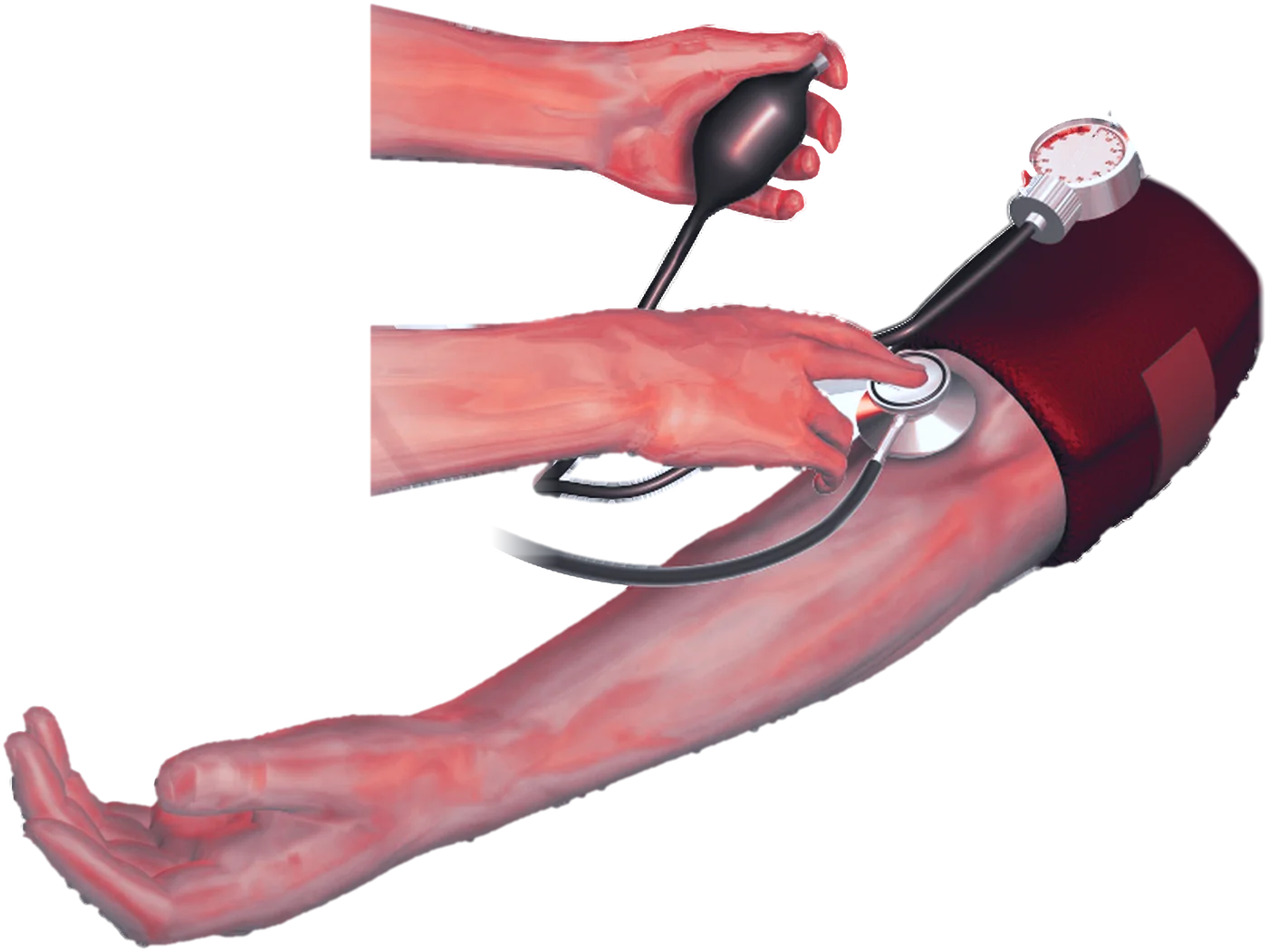
Few numbers in medicine carry as much weight as a blood pressure reading. It can start a medication, change a dose, or follow you through a chart for years. So it is worth understanding how fragile that number is, and how much of its fragility comes from the two minutes before it ever appears on the screen.
Start with the cuff. In a randomized crossover trial published in JAMA Internal Medicine in 2023, the same adults had their pressure taken with a correctly sized cuff and with a standard regular cuff. In people whose arms actually required an extra large cuff, the regular one read 19.5 mm Hg higher on the top number. In those who needed a large cuff, it read 4.8 mm Hg higher. In people with smaller arms, the regular cuff read about 3.6 mm Hg lower.2 That is not measurement noise. At the top end, that is the gap between a routine visit and a new prescription.
A regular cuff against the right size
- Needed an extra large cuff19.5higher
- Needed a large cuff4.8higher
- Smaller armsabout 3.6lower
Top number, in mm Hg, compared with a correctly sized cuff.
The cuff is not a formality. It is part of the measurement.
Where your arm is sitting
A second trial from the same group, published in 2024, isolated arm position and nothing else. Compared with the arm supported on a desk at heart level, resting the hand in the lap raised the systolic reading by about 3.9 mm Hg, and letting the arm hang unsupported at the side raised it by about 6.5 mm Hg.3 Most of us have had our pressure taken with an arm balanced on a knee or dangling at our side while we answered questions about our medication list.
Which brings up the questions themselves. Guidelines ask you to empty your bladder, sit quietly with your back supported and your feet flat, and stay silent during the reading. Those instructions exist because each of those conditions moves the number in a predictable direction. None of these is a rounding error. The American Heart Association puts a full bladder at up to 33 mm Hg and talking at up to 19, and nothing says they have to arrive one at a time.1
What a careful reading looks like
The American Heart Association's own instructions are unglamorous. Empty your bladder. Sit quietly for at least five minutes with your back supported and your feet flat on the floor. Place the cuff on bare skin, on the upper arm, at heart level, with the arm resting on a surface. Do not talk and do not scroll. Take two readings a minute apart and write both down.4
None of this is a reason to distrust your clinic. It is a reason to pay attention to technique, including at home, where a properly taken series of readings is often more informative than one number captured in a hurry. If your readings are borderline, or if they swing, bring your home log and an honest account of how you took it to the clinician who manages your care, and work out together what the number is actually telling you.
References
- Muntner P, Shimbo D, Carey RM, et al. Measurement of Blood Pressure in Humans: A Scientific Statement From the American Heart Association. Hypertension. 2019;73(5):e35-e66. Read the source
- Ishigami J, Charleston J, Miller ER 3rd, Matsushita K, Appel LJ, Brady TM. Effects of Cuff Size on the Accuracy of Blood Pressure Readings: The Cuff(SZ) Randomized Crossover Trial. JAMA Internal Medicine. 2023;183(10):1061-1068. Read the source
- Liu H, Zhao D, Sabit A, et al. Arm Position and Blood Pressure Readings: The ARMS Crossover Randomized Clinical Trial. JAMA Internal Medicine. 2024;184(12):1436-1442. Read the source
- Jones DW, Ferdinand KC, Taler SJ, et al. 2025 AHA/
ACC/ Circulation. 2025;152(11):e114-e218. Read the sourceAANP/ AAPA/ ABC/ ACCP/ ACPM/ AGS/ AMA/ ASPC/ NMA/ PCNA/ SGIM Guideline for the Prevention, Detection, Evaluation and Management of High Blood Pressure in Adults.
Education, not medical advice.
Take any decision about your own heart with the clinician who knows your history.
Illustration: BruceBlaus / Blausen Medical, CC BY-SA 4.0 (adapted).